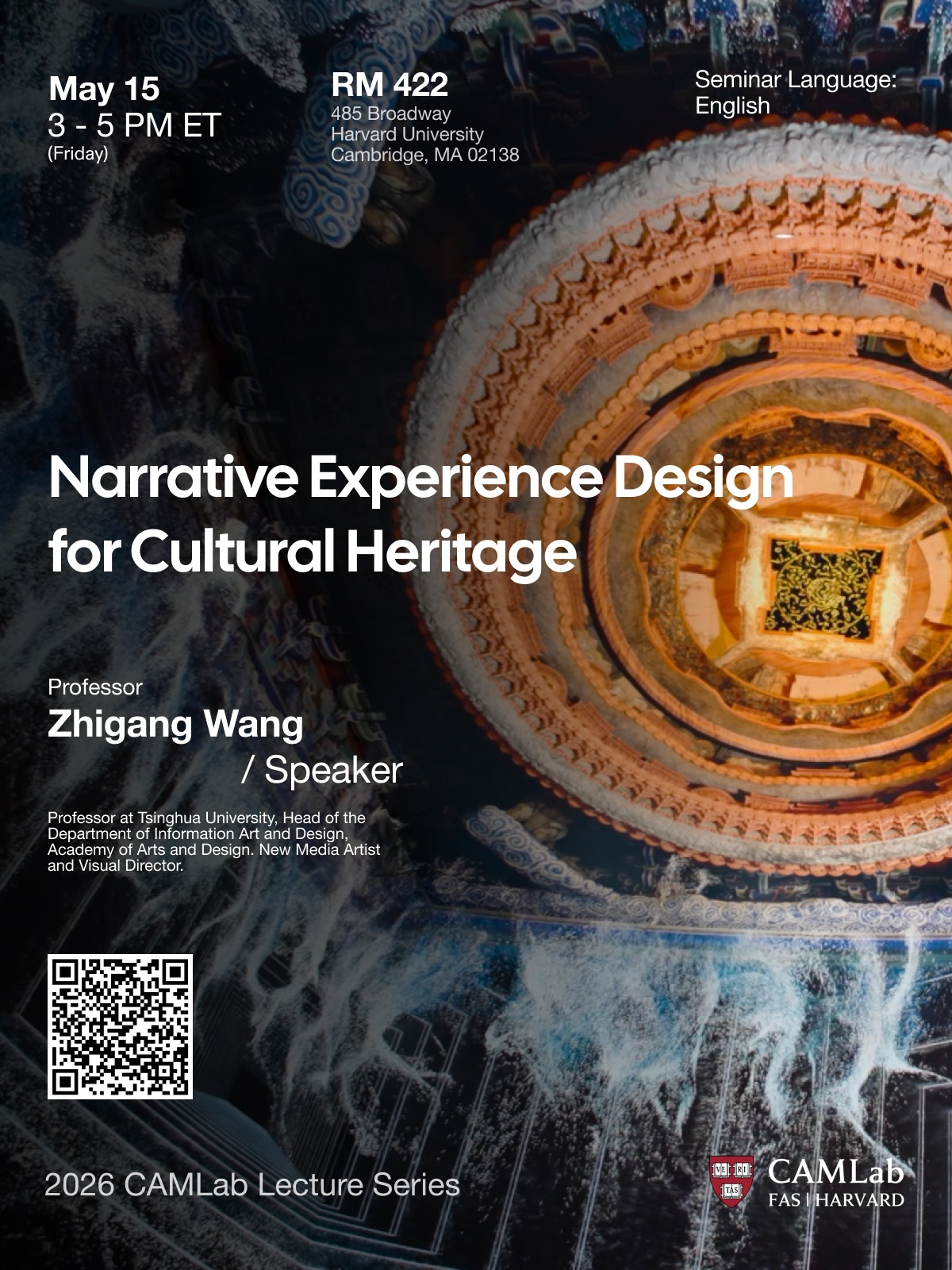
May 15, 2026 (Friday)
3:00 – 5:00 PM ET
RM 422
485 Broadway, Harvard University
Abstract
For a long time, the field of cultural heritage transformation has tended to conflate the application of technology and the digitization of cultural symbols with the actual practice of heritage transmission. This has led to a cognitive trap in which technology becomes detached from culture, and external forms are severed from their intrinsic cultural core. As a crucial means of overcoming this predicament and supporting the generation of contemporary meaning for cultural heritage, narrative innovation—when examined through a research perspective that transcends instrumental rationality—can construct a transformation pathway centered on narrativity. This, in turn, provides a new theoretical and practical dimension for the living transmission of cultural heritage.
The series of creative practices undertaken by Professor Wang Zhigang from the Academy of Arts & Design at Tsinghua University, offers a systematic practical response to this cognitive breakthrough. Specifically, the project House of Heaven translates the cultural core and aesthetic characteristics of ancient caisson ceilings through narrative logic; Return to Haiyantang employs spatial narrative to interweave historical scenes with cultural memory; The Skeleton Fantasy Show uses interactive installations to interpret the philosophical depth embedded in ancient painting; and Longitude and Latitude uses narrative logic to give tangible form to the heritage lineage of Suzhou’s regional culture.
The core of this theoretical innovation lies in explicitly establishing the centrality of narrativity in cultural heritage experience design and constructing a tripartite transformation framework of “Culture–Narrative–Technology.” By reconstructing narrative logic, this approach builds a bridge for dialogue between antiquity and the present, generating cultural meanings that resonate with contemporary social contexts and value systems. Ultimately, it helps mediate the dualistic tensions between Eastern and Western paradigms, as well as the perceived divide between antiquity and modernity, thereby enriching the theoretical system of living heritage and offering important theoretical references and practical paradigms for the global discourse on cultural heritage transformation.
Speaker Bio
Zhigang Wang is a Professor at the Academy of Arts & Design, Tsinghua University, where he serves as Head of the Department of Information Art and Design. A new media artist and visual director, his work focuses on the digital transformation of cultural heritage, spatial narrative, and immersive media practices. Through interdisciplinary approaches that integrate art, technology, and cultural research, he explores new models for the contemporary reinterpretation and transmission of heritage. Wang also served as Visual Director for the Beijing 2022 Paralympic Games Ceremonies.
Event Information
- Free and open to the public
- May 15th (Friday)
- 3:00 – 5:00 PM ET
- This is an in-person event.
Please note
Advanced RSVP required.
The event will be conducted in English.
May 15, 2026 (Friday)
3:00 – 5:00 PM ET
RM 422
485 Broadway, Harvard University