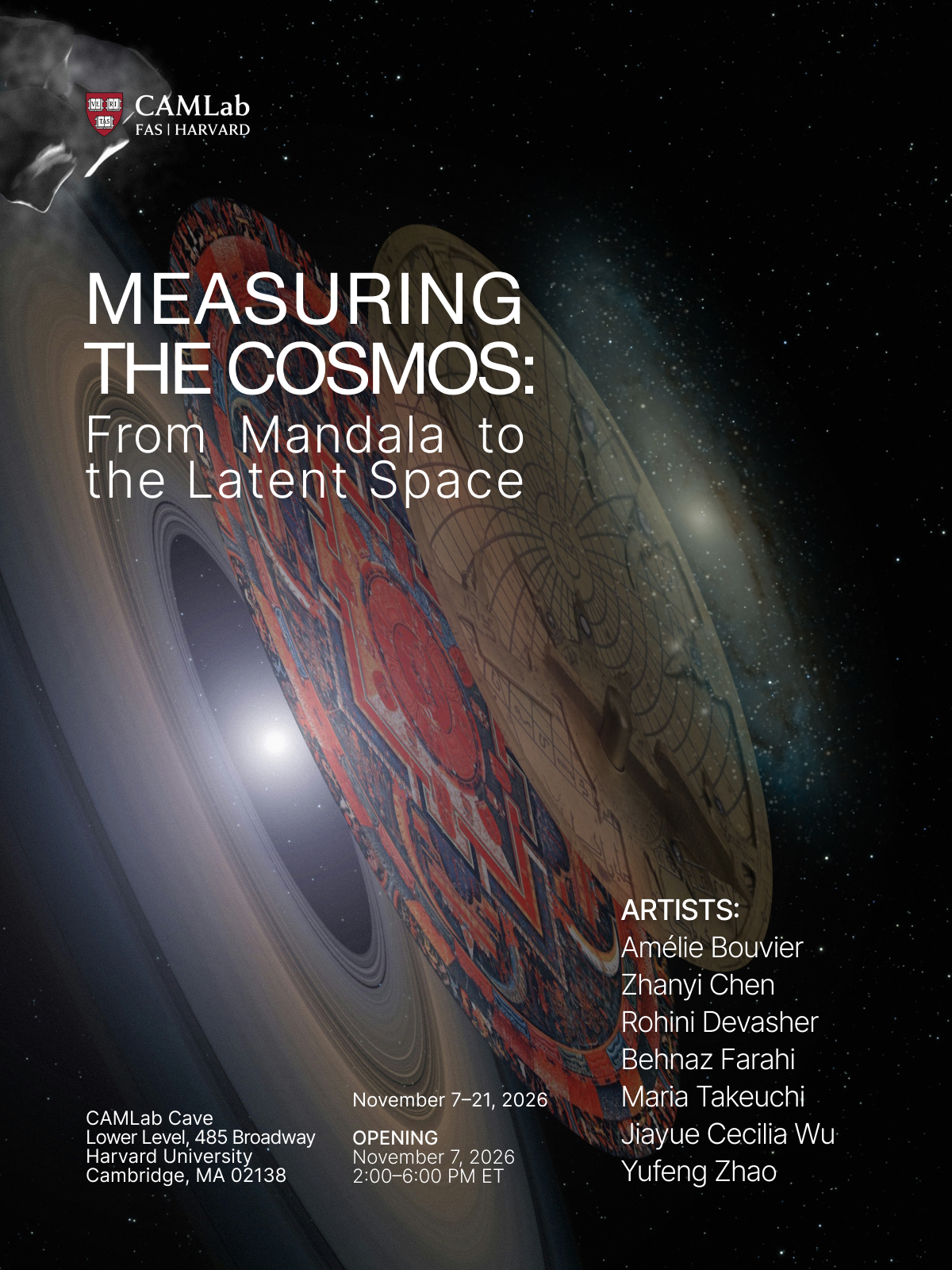
Dates: November 7–21, 2026
Hours: Friday–Sunday, 11:00 AM–4:00 PM ET
Opening: November 7, 2:00–6:00 PM ET
About
To measure the world is to generate it. Across Buddhist, Islamic, and other Asian traditions, astronomical, geomantic, and architectural calculations were never treated as neutral descriptions, but as ways of bringing a world into being. The Islamic astrolabe turns the sky into calculable coordinates. The Chinese revolving lantern sets a painted world in motion by heat and light. In Borobudur, a pilgrim’s body computes cosmological ascent as they climb the terraces of a 9th-century Buddhist stupa.
Artificial intelligence performs that same operation today, under the sign of technical neutrality, occluding what these traditions held in full view. A generated image is only the visible surface of a much larger, invisible act of measurement. Every time a machine learns, it measures: embeddings compute distance, loss functions minimize error, latent spaces propose coordinates that behave as worlds. A trained model is a cosmogram, an object that maps the universe and, in the same gesture, generates one.
The exhibition unfolds in three parts.
Apparatus of the Cosmos brings together pre-modern measuring instruments as image-generating devices. At its center are reproductions of glass plates from the Harvard Plate Stacks, which astronomers, many of them women, used beginning in 1886 to measure, catalog, and image the night sky, laying the groundwork for modern astronomy. This section is the exhibition’s archaeological layer, establishing its historical foundations.
The Measuring Body turns to how contemporary practice reactivates this measure-to-generate operation through new media, engaging the history of astronomical observation, satellite and orbital data, and cross-continental measurement.
Cosmology of the Latent Space reconsiders this central operation of Artificial Intelligence as a contemporary cosmogram: when a coordinate system determines what can be rendered visible, measurement becomes part of cosmology itself.
Artists
Amélie Bouvier, Zhanyi Chen, Rohini Devasher, Behnaz Farahi, Maria Takeuchi, Jiayue Cecilia Wu, Yufeng Zhao
Schedule
Opening Program | November 7
2:00 PM — Doors Open
2:30 PM — Opening Remarks
3:00 PM — Artist Remarks
3:30 PM — Live Performance by Maria Takeuchi and Alec Fellman
4:30 PM — Reception
6:00 PM — Closing
Exhibition Dates and Hours
November 7–21, 2026, Friday–Sunday, 11:00 AM–4:00 PM ET
Free and open to the public. Resignation is required.
Featured Installations

Amélie Bouvier
Eight Minutes Ago2019
Two-channel HD video, edition of 5 + 2 AP
Duration: 9 min. 15 sec.
It takes approximately eight minutes for the light of the sun to reach our retinas. Amélie Bouvier’s two-channel video Eight Minutes Ago grapples with this distance between us and the stars. On one screen, NASA sound recordings of planets in our solar system mixed with experimental sounds created by the artist accompany imagery drawn from or inspired by Harvard’s collection of astronomical photographic glass plates. Shots of dust settling in the air, dark shadows emerging on weathered glass, or an archivist wiping clean notations made by hand all convey the tenuousness of our personal and collective heritage. In a scrolling text on the pendant screen, Bouvier’s then ninety-three-year-old father shares memories of growing up and aging refracted through ruminations on the night. Together, the two channels express the belatedness and fragility of the human experience. As an inscription on Johannes Kepler’s tombstone reads, “I used to measure the heavens, now I shall measure the shadows of the earth. Although my soul was from heaven, the shadow of my body lies here.” Special thanks to Thomas Burns.

Zhanyi Chen
Tele-Sky Unplugged
2023
Tele-Sky Unplugged (2023) reinterprets Aldo Tambellini’s Tele-Sky (1981), which displayed live sky images transmitted from three countries on CRT televisions. The recreation replaces the TV’s electronic components with a mirror and lens, transforming it into an optical device that reflects the viewer’s immediate sky rather than displaying distant skies through satellite transmissions and digital signals.
The original Tele-Sky (1981) was part of the Sky Art movement that peaked during the 1980s, centered at the Center for Advanced Visual Studies at MIT. Tele-Sky Unplugged (2023) extends the Sky Art artists’ exploration of the sky as a canvas to the sky itself as media, an integral part of our cultural landscape. It also critiques the infrastructures silently integrating into our surroundings and the politics of satellite technology, while creating a dialogue between artists who lived under the Space Race and Cold War-era sky and the sky of today.
Rohini Devasher
Glasshouse Deep
2021
Single-channel video
Duration: 14 min. 21 sec.
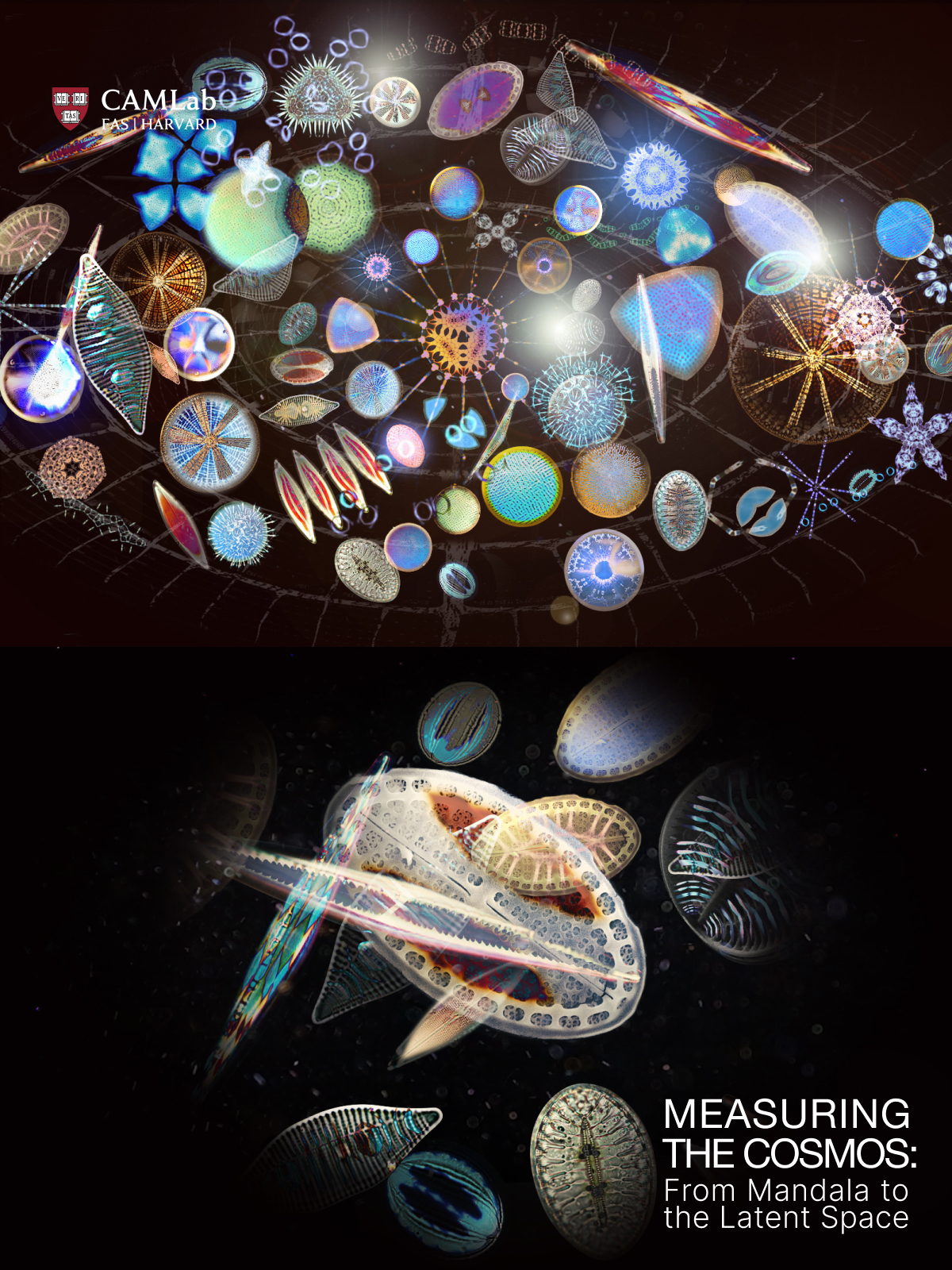
Glasshouse Deep is a journey into the minute world of the strange deep, where the very small assumes a planetary scale. Reflective, refractive, and luminous, organic forms evolve through space, following speculative trajectories and migrations that telescope inward and outward.
The organisms that populate Glasshouse Deep draw inspiration from diatoms, single-celled algae that transform sunlight into chemical energy through photosynthesis. Unlike plants, diatoms also possess a urea cycle, a feature they share with animals. This remarkable hybridity, shaped by their evolutionary ancestry and horizontal gene transfer from marine bacteria, is reflected in their extraordinary diversity of form. With intricate glass exoskeletons exhibiting bilateral and radial symmetries, diatoms reveal patterns that also emerge in unexpected domains, including digital systems capable of spontaneously organizing into increasingly complex structures.
Part of a series of works employing video feedback to explore growth and evolution through a technological matrix, Glasshouse Deep investigates the underlying physical and chemical processes that govern biological form and their parallels in the digital sphere.
Light is a central protagonist. Its intensity and spectral qualities influence the movement and photoprotective behavior of diatoms. In the digital realm, video feedback creates a recursive flow of light between a camera and a monitor, generating intricate, evolving forms. Expanding and contracting disks, oscillating points, radiating pinwheels, and starbursts unfold into complex patterns of light and color, revealing how increasing complexity gives rise to new possibilities for structure and change.

Behnaz Farahi
Gaze to the Stars
2025
Media installation with spatialized sound
Duration: 60 min.
Collaborator: Critical Matter Group, MIT Media Lab
Gaze to the Stars is a participatory project that transforms MIT’s Great Dome into a vessel for collective storytelling. Inspired by the motto per ardua ad astra—“through difficulties to the stars”—the work explores how architecture might listen, feel, and share intimate expressions of struggle, hope, and transformation.
More than 200 participants entered a custom-built sensory pod, where they shared dreams, fears, and aspirations in conversation with an AI voice embodied by the Dome itself. Their eye movements and spoken stories were recorded, with each narrative summarized, encoded in Braille, and paired with close-up moving portraits of their eyes.
Over three nights, these gazes and stories were projection-mapped across the 100-foot-wide Dome, transforming an icon of institutional knowledge into a civic platform for vulnerability, empathy, and shared experience.
Maria Takeuchi
membrane – elements
2026
Four-channel video installation with sound
Duration: 40 min
Collaborator: Alec Fellman
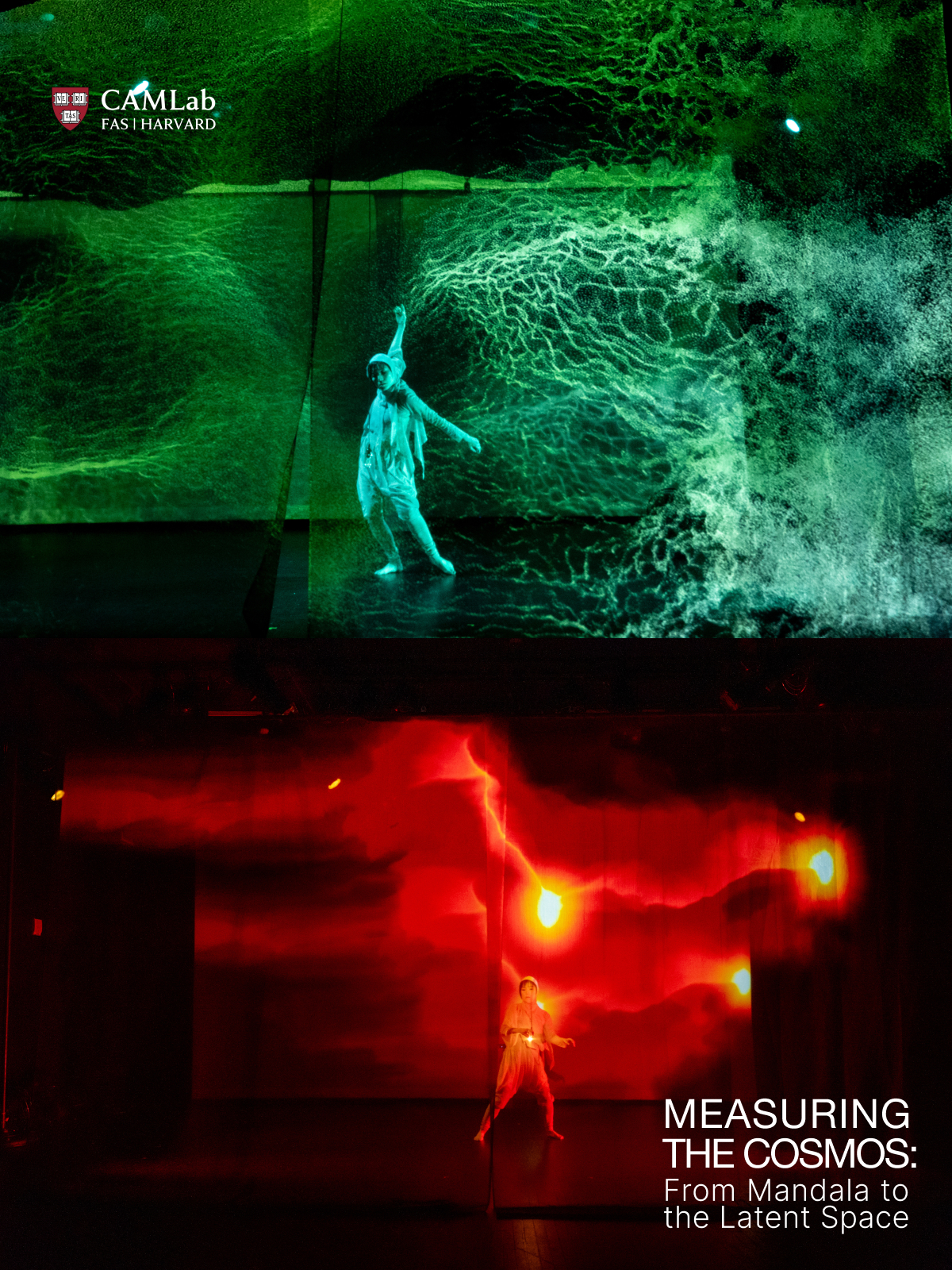
membrane – elements is an installation created for CAMLab’s Infinite Room, adapted from the theatrical piece membrane | 虚実皮膜. The work focuses on the elements—water, air, fire, and earth—as representations of birth, life, death, and rebirth, exploring their cyclical nature.
Extending the original piece, the work draws on elemental philosophies from Asian and ancient African traditions to create a liminal space where our spirits may exist in a dream state between life and death.
membrane | 虚実皮膜 (2024) was a multidisciplinary collaboration between movement artist Yoko Murakami and multimedia artist Maria Takeuchi, incorporating motion-tracking technology. The work draws inspiration from the theory of 虚実皮膜 (Kyojitsu Himaku), attributed to playwright Chikamatsu Monzaemon, which holds that the artistic truth lies on the fine line between fiction and fact.
In this installation, translucent screens embody this “membrane,” a threshold where dualities meet.

Jiayue Cecilia Wu
Embodied Sonic Meditation No. 1: Virtual Mandala — Variation: Mirrored Mandalas
2026
Two synchronized audiovisual installations
Duration: 6 min. 15 sec.
Mirrored Mandalas reimagines Tibetan Buddhist sand mandala traditions through embodied interaction, electroacoustic composition, and immersive digital art. Inspired by the ritual creation and dissolution of sand mandalas, the work explores impermanence while translating contemplative philosophies into a dynamic, participatory audiovisual experience.
Using motion tracking and physical computing, the artist activates 4.5 million digitally simulated particles through expressive gestures and musical performance, transforming bodily movement into evolving sonic and visual forms.
This variation introduces two mirrored mandalas featuring Mahākāla, who embodies protective power and fierce compassion, and Vajravārāhī, who represents transformative feminine energy and transcendent wisdom. Their synchronized interplay evokes the interdependence of compassion and wisdom, as well as masculine and feminine energies.
Bridging ancestral knowledge and emerging technologies, the project investigates how embodied digital expression can reinterpret cultural heritage, cultivate contemplative awareness, and invite contemporary audiences to engage with encounters with Buddhist philosophical and artistic traditions in new ways.

Yufeng Zhao
Earth is the Oldest Stereoscope
2026
Two-channel video installation: widescreen projection and a Looking Glass Portrait holographic display
Duration: 17 min. 22 sec.
Earth is the Oldest Stereoscope is a computationally aligned stereo pair of the Moon, captured simultaneously from Boston and Santiago during the lunar eclipse on March 2, 2026. Two people, on two rooftops, with two telescopes of the same model, shooting one Moon. The baseline between the cameras is about 4,800 miles (7,800 km), more than half an Earth diameter.
The work’s title is in dialogue with Nam June Paik’s Moon Is the Oldest TV (1965). Where Paik cast the Moon as humanity’s first screen, Zhao extends this substitution to the Earth. Drawing on astronomical observation, computational imaging, and human perception, the work reconsiders how viewing position and distance shape an image.
Dates: November 7–21, 2026
Hours: Friday–Sunday, 11:00 AM–4:00 PM ET
Opening: November 7, 2:00–6:00 PM ET