June 18, 2026 (Thursday)
12:00 – 1:30 PM ET
CAMLab Cave, Lower Level
485 Broadway, Harvard University
Abstract
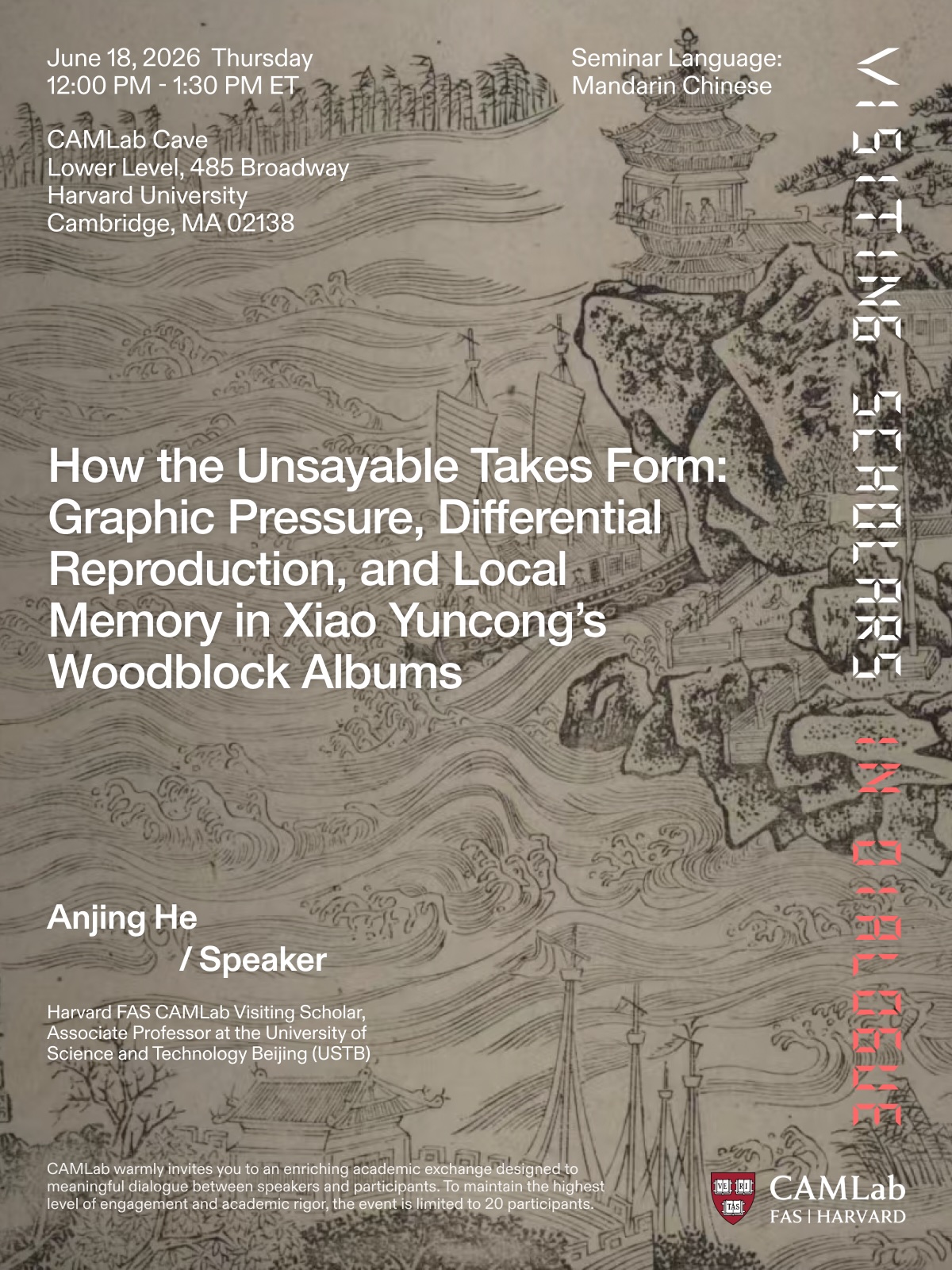
This lecture takes Xiao Yuncong’s Lisao tu 離騷圖 and Taiping shanshui tuhua 太平山水圖畫 as its central case studies, and reconsiders the historical significance and medial character of late Ming and early Qing woodblock albums. Such albums were not merely derivative reproductions of painting; they functioned as visual mechanisms capable of bearing historical pressure, organizing local knowledge, and preserving cultural memory. In the dynastic transition from Ming to Qing, when language, political discourse, and official narratives could no longer adequately articulate traumatic experience, images began to assume the expressive work of what could not be openly said. The blanks, compressions, strangeness, and visual overload in Lisao tu are therefore not simply stylistic phenomena, but structural effects of historical pressure entering the woodblock page.
A close comparison of three important surviving copies of Taiping shanshui tuhua further suggests a research path centered on “differential reproduction.” The evidence shows that woodblock reproduction did not guarantee the fixity of the image. On the contrary, block wear, variations in paper and ink, cropping, block replacement, and binding practices continually generated new visual differences. The supposedly stable relationship between “original” and “copy” is thus rewritten in the case of woodblock albums, and pictorial meaning is formed and re-formed across the life history of the blocks.
At the same time, the maps, catalogues, divided notes, colophons, and images in Taiping shanshui tuhua together constitute a visual system for retrieving local knowledge. This system borrows the structures of gazetteers and official archives, yet repeatedly exposes their omissions and absences, thereby giving rise to an alternative “local archive.” Woodblock albums, in this sense, belong not only to art history, but also to the making of historical memory, visual knowledge, and media culture.
Speaker Bio
He Anjing is an Associate Professor at the University of Science and Technology Beijing and a Visiting Scholar at Harvard FAS CAMLab. He holds a Ph.D. in Fine Arts from the Central Academy of Fine Arts and was a Postdoctoral Fellow at the Institute of World Religions, Chinese Academy of Social Sciences. His research and artistic practice engage with Chinese and Western philosophy, particularly aesthetics, material culture, and the relationship between art and lived experience. He is a member of the China Artists Association.
Event Information
- Free and open to the public
- June 18th (Thursday)
- 12:00 – 1:30 PM ET
- This is an in-person event.
Please note
Advanced RSVP required.
The event will be conducted in Mandarin Chinese.
June 18, 2026 (Thursday)
12:00 – 1:30 PM ET
CAMLab Cave, Lower Level
485 Broadway, Harvard University