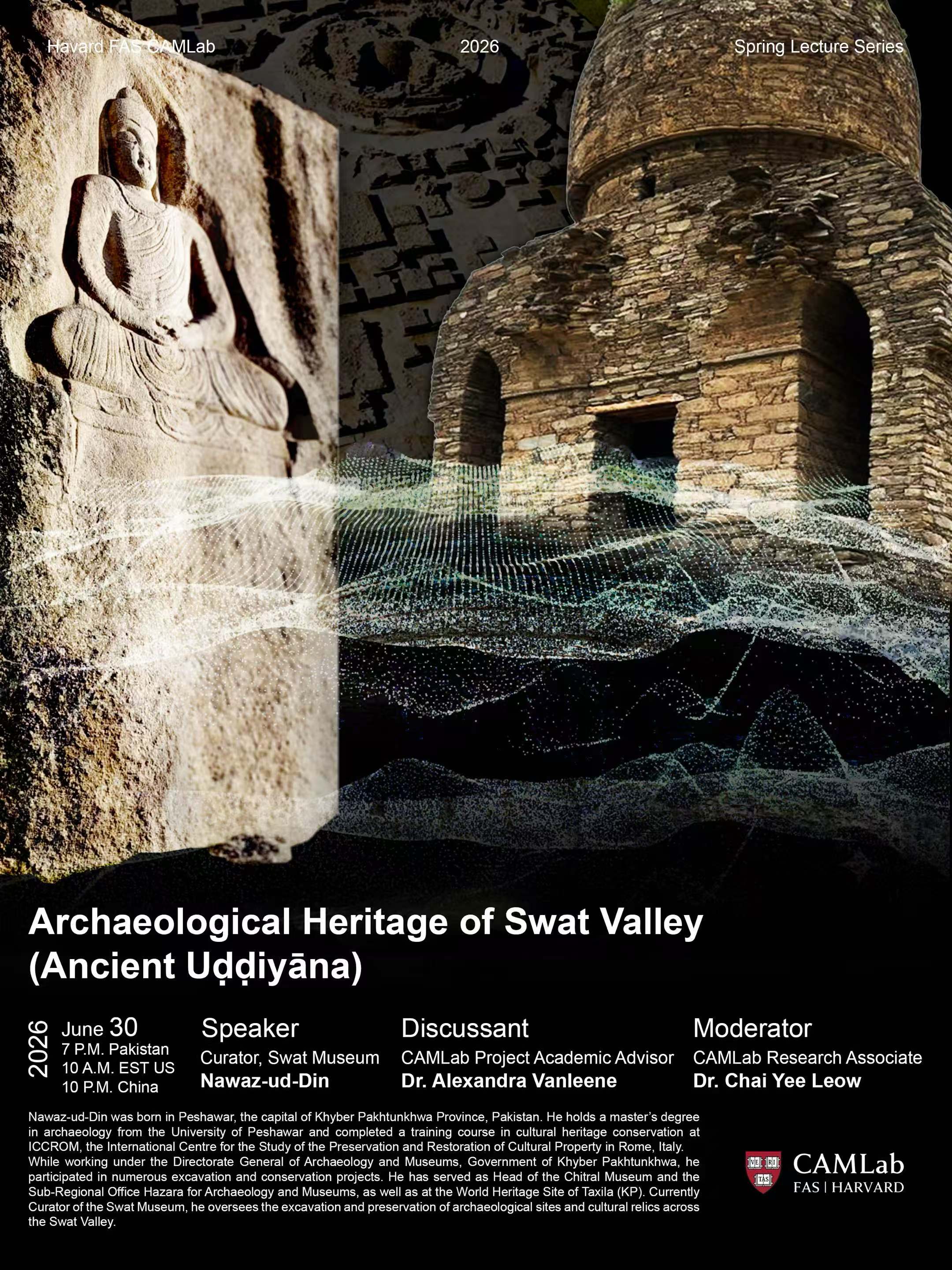
June 30, 2026 (Tuesday)
10:00 AM ET
Online Zoom Conference
Abstract
Uḍḍiyāna (Sanskrit for “garden”) was the ancient name for the present-day Swat Valley. The valley was conquered by Alexander the Great in 327 B.C. Macedonian control over the region began in 326 BCE but was short-lived, largely due to resistance and rebellion among local forces. It was followed by a succession of Indo-Greek, Saka, Parthian, Kushan, Sasanian, and Hephthalite rulers. The region flourished as a prosperous trading center and, at the same time, became a major center of Buddhist learning, with numerous monasteries dispersed throughout the landscape. An important stopover on the way to the holy places of Buddhism, it was visited by numerous Chinese pilgrims, including Faxian in the 5th century CE Songyun in the 6th, and Xuanzang in the 7th.
Swat was always characterized by the powerful influence that the local – Dardic – Substratum exercised over Buddhism, to the extent that it became a center for the formulation and dissemination of esoteric doctrines merging into the “Diamond Vehicle” (Vajrayana) tradition. It was in fact from here that Padmasambhava, the moving force of Tibetan Buddhism, set out in the 8th century, and it was indeed the accounts of this “holy land” of Buddhism contained in the Tibetan texts that brought Giuseppe Tucci, founder of the Italian Archaeological Mission, here in 1955.
Discussant:Dr. Alexandra Vanleene
Moderator:Dr. Chai Yee Leow
Speaker Bio
DNawaz-ud-Din was born in Peshawar, the capital of Khyber Pakhtunkhwa Province, Pakistan. He holds a master’s degree in archaeology from the University of Peshawar and completed a training course in cultural heritage conservation at ICCROM, the International Centre for the Study of the Preservation and Restoration of Cultural Property in Rome, Italy.
While working under the Directorate General of Archaeology and Museums, Government of Khyber Pakhtunkhwa, he participated in numerous excavation and conservation projects. He has served as Head of the Chitral Museum and the Sub-Regional Office Hazara for Archaeology and Museums, as well as at the World Heritage Site of Taxila (KP). Currently Curator of the Swat Museum, he oversees the excavation and preservation of archaeological sites and cultural relics across the Swat Valley.
Discussant Bio
Alexandra VANLEENE is a doctor of Antiquity Science, specializing in Buddhist art and archaeology of Gandhāra. Her research mainly focuses on the artistic tradition of modeling in the decor of Buddhist monasteries in Afghanistan, particularly in Haḍḍa, the geographical expansion of Gandhāra art, and the development of its regional characteristics. From 2005 to 2012, she served as the head of archaeological operations as part of the Franco-Afghan mission for the survey and excavations of Bāmiyān led by Prof. Zémaryalaï Tarzi. Since 2021, she has been participating in the Digital Gandhara Project of the Harvard FAS CAMLab as an independent academic advisor.
Event Information
- Free and open to the public
- June 30th (Tuesday)
- 10:00AM ET
Please note
The event is online and will be conducted in English.
June 30, 2026 (Tuesday)
10:00 AM ET
Online Zoom Conference