
Borobudur, located in the Magelang region of Java, Indonesia, is a monumental Buddhist structure dating to the Śailendra dynasty (ca. 8th–9th century CE). Renowned not only for its vast scale and exquisite relief carvings, Borobudur also stands out for the conceptual and spatial complexity of its design, making it a crucial site for understanding the transregional Buddhist civilization network of the Indian Ocean during the 8th and 9th centuries.
Moreover, the construction of Borobudur was by no means an isolated regional design. The Śailendra dynasty maintained close relations with the kingdom of Śrīvijaya on the island of Sumatran, which, from the mid-seventh century onward, had emerged as a major Buddhist center facilitating maritime exchange between India, China, and the Arab world.
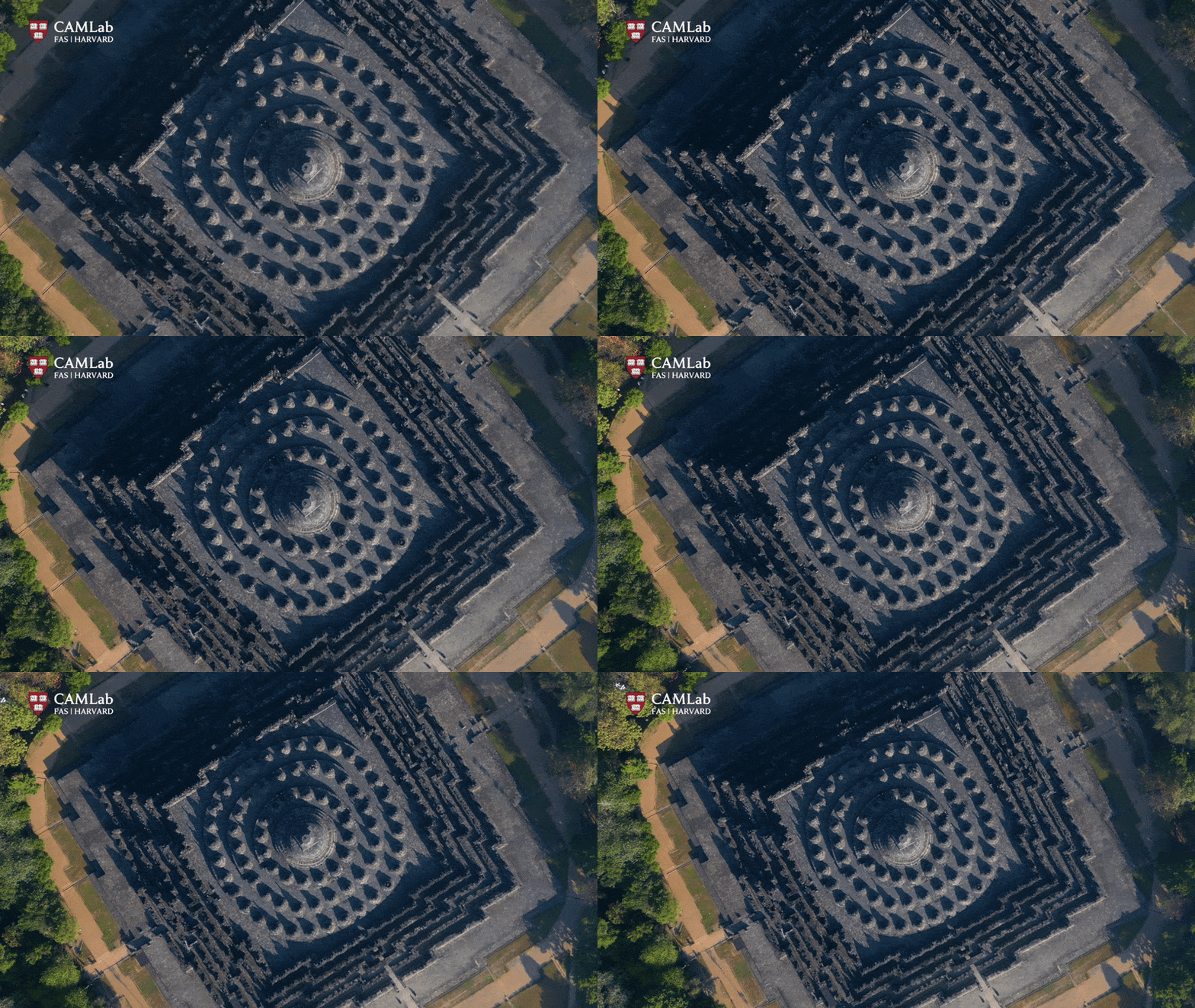
The Śailendra dynasty represented a period in Javanese history when religious and political power flourished under the influence of Buddhism. Its belief system was deeply shaped by Mahāyāna Buddhist thought while also engaging in profound cultural synthesis with indigenous Hindu traditions. Scholarly research has shown that the construction of Borobudur served both as a political expression of the dynasty’s pious devotion to the Dharma and as an artistic manifestation of the cultural confluence between Indian and Javanese civilizations. Architecturally, Borobudur integrates the symbolic structure of a stūpa and a Vajradhātu-maṇḍala, embodying in spatial form the Mahāyāna Buddhist cosmology of dharmadhātu-pratītyasamutpāda—the interdependent origination of the cosmic realm.
Moreover, the construction of Borobudur was by no means an isolated regional design. The Śailendra dynasty maintained close relations with the kingdom of Śrīvijaya on the island of Sumatran, which, from the mid-seventh century onward, had emerged as a major Buddhist center facilitating maritime exchange between India, China, and the Arab world. The architectural forms, sculptural programs, and pilgrimage rituals embodied at Borobudur were deeply rooted in this interregional network of exchange—shaped through the pilgrimage of monks, the transmission and translation of scriptures, and the diffusion of iconographic and artistic models. As such, Borobudur epitomizes a multi-sourced synthesis born of sustained transcultural interaction across the Indian Ocean world.
Digital Borobudur: Envisioning the Future Legacy
Building on this scholarly understanding, the “Digital Borobudur” project employs digital modeling and semantic restoration to recreate both the architectural structure and the relief program of the monument. This approach enables researchers to reconstruct the complex intercultural networks of Buddhist imagery embedded within Borobudur’s design. Through such work, we may gain new insight into how, in 8th–9th century Java, Borobudur’s architecture, iconography, and ritual practice collectively materialized Buddhist philosophical concepts within a spatial framework—transforming abstract thought into architectural language. Ultimately, Borobudur stands as a paradigmatic expression of the Buddhist cosmos rendered in stone: a visualized scripture, where form itself becomes the embodiment of the Dharma.
Stay tuned for future updates on our “Digital Borobudur” digital heritage initiative.