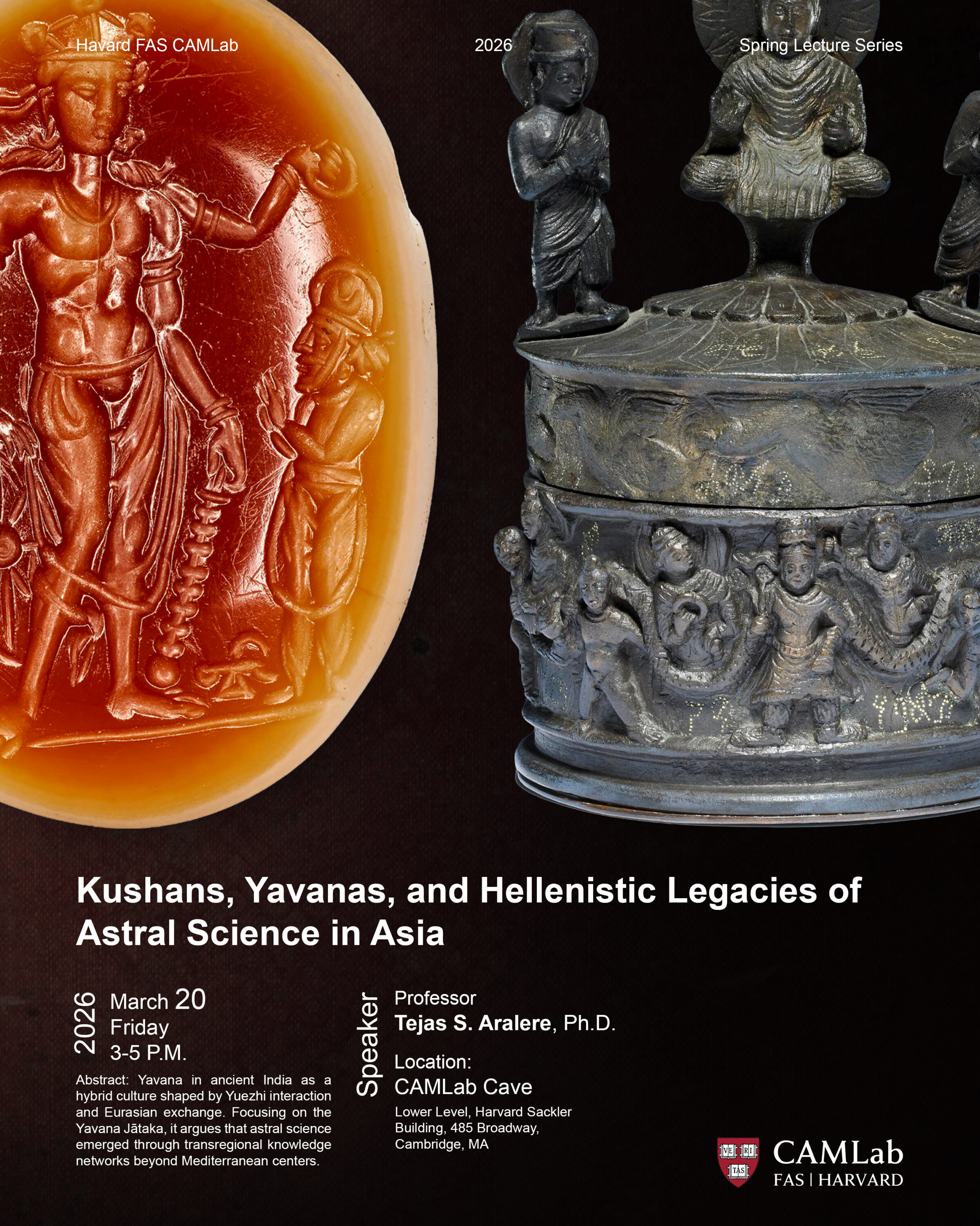
March 20, 2026 (Friday)
3:00 – 5:00 PM ET
CAMLab Cave, Lower Level
485 Broadway, Harvard University
Abstract
This talk presents evidence that re-examines the legacy of Hellenism in India by reassessing the identity of the “Yavana” ethnonym often applied to Greeks living in Northwestern ancient India, generally named Bactria. The term is a Sanskrit transliteration of “Ionia” by way of the Achaemenid Yona. But this traditional narrative omits their interaction with the Yuezhi, the Central Asian warrior tribes who migrated south and established the Kuṣāṇa (Kushan) Empire (1st cent. BCE–4th cent. CE). This talk challenges the prevailing view of the Yavanas as “Indo-Greeks” by situating them as an innovative culture within the broader geopolitical context of Eurasian and Sino-Indian framework of exchange. Building on my first monograph-in-progress, “Cosmic Embodiment: Astrological Melothesia in the Ancient Mediterranean and South Asia,” I argue that the fusion of Greco-Babylonian zodiacal theory with Indian jyotiṣa in the Yavana Jātaka, a 2nd-century CE Sanskrit astral science treatise, arose from intellectual contact zones such as the ancient university town Takṣaśilā (Taxila), where Hellenistic, Indian, and Yuezhi populations converged and became vital trading partners with the Roman Empire. By integrating textual, numismatic, and epigraphic evidence, my talk emphasizes how the Yuezhi-Yavana networks transformed Hellenistic identity and facilitated transregional development of astral science by linking the ancient Mediterranean with China. This talk relocates the development of scientific knowledge from Alexandrian and Mediterranean centers to Eastern loci, reframing Hellenistic-era knowledge production, preservation, and propagation as occurring within a rich network of ancient academic centers.
Speaker Bio
Tejas S. Aralere(pronounced Tay-Jus) is an Assistant Professor of Classics and Humanities at the University of New Hampshire-Durham.He recently completed his Ph.D. in Classics with a double emphasis in Ancient Mediterranean Studies and Classical Literature and Theory at the University of California, Santa Barbara.
Event Information
- Free and open to the public
- March 20th (Friady)
- 3:00 – 5:00 PM ET
- This is an in-person event.
Please note
Advanced RSVP required.
The event will be conducted in English.
March 20, 2026 (Friday)
3:00 – 5:00 PM ET
CAMLab Cave, Lower Level
485 Broadway, Harvard University