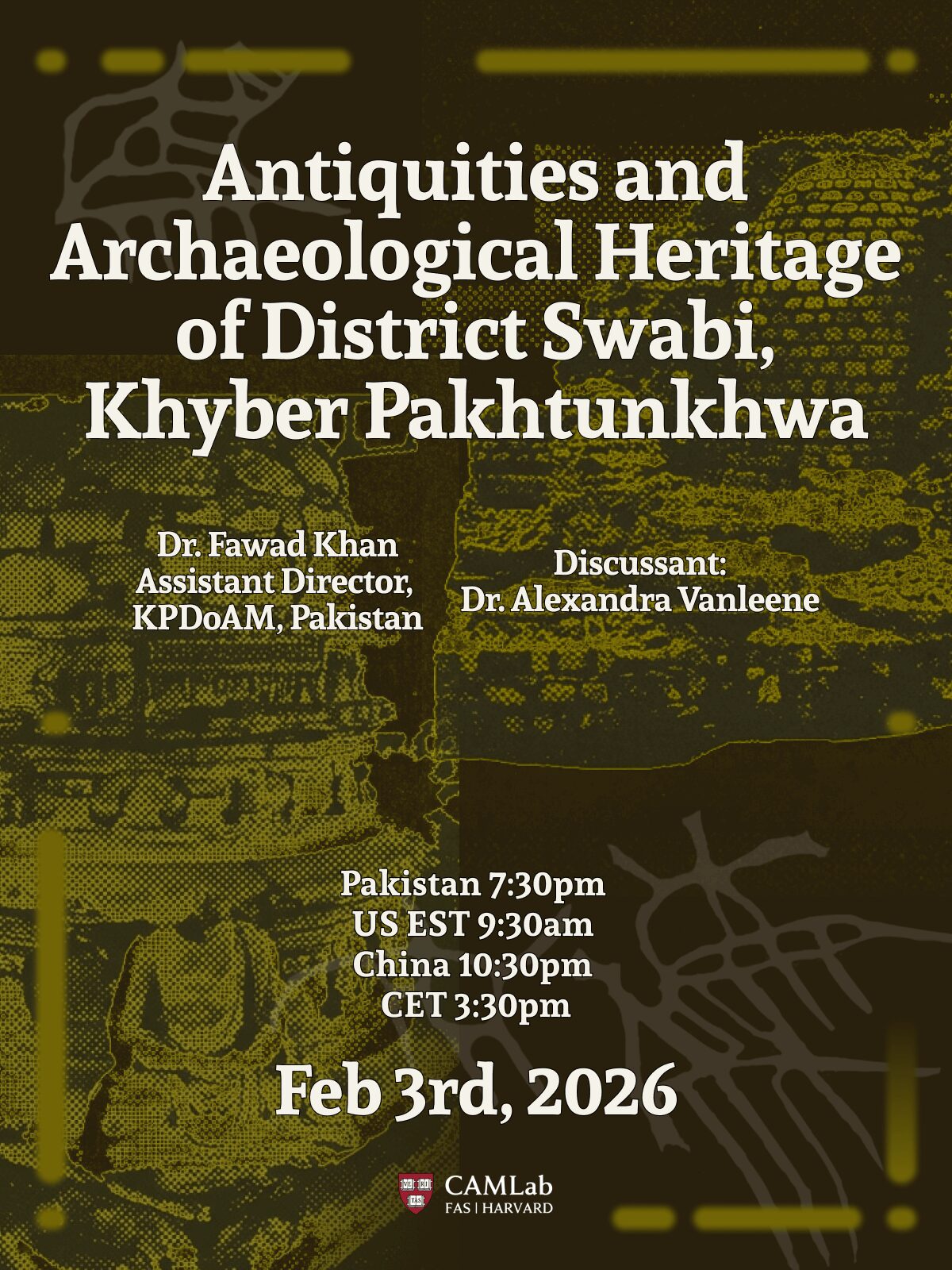
February 3, 2025 (Tuesday)
9:30AM US ET, 7:30PM Pakistan, 10:30PM China, 3:30PM CET
Online Zoom
Abstract
District Swabi, located in the easternmost part of the Khyber Pakhtunkhwa province of Pakistan, holds significant historical and archaeological value due to its strategic position at the crossroads of various empires and cultures. The origin of its name remains debated among scholars, with proposed derivations from either Sanskrit or Persian— interpreted as referring to a place associated with water or a settlement near a “Red River.”
Historically, Swabi has been prominent since the 6th century BCE, first coming under the suzerainty of the Achaemenid Empire. It was subsequently conquered by Alexander the Great in 327 BCE, who briefly stayed in the area before his army crossed the Indus River. The Mauryan Empire annexed Swabi around 322 BCE, followed by periods of Bactrian Greek and Kushan rule. The region later witnessed a succession of rulers, including the Scythians, Parthians, and Kushan influences, before falling under the control of the Sassanids, Kidarites, and other local dynasties. Notably, the Hindu Shahis established their rule in 823 CE, with Hund serving as their capital.
Swabi also attracted foreign travelers and chroniclers—among them Greek travelers, Chinese pilgrims, and Arab historians—who documented its political and religious significance. Archaeological exploration in the region began in the early 19th century, and since then hundreds of sites have been documented, spanning periods from prehistory to the historic, medieval, and colonial periods.
This presentation highlights the rich archaeological landscape of District Swabi, demonstrating its long-standing cultural continuity and its pivotal role in the historical development of the Gandhara region.
Speaker:Dr. Fawad Khan
Discussant:Dr. Alexandra Vanleene
Moderator:Dr. Chai Yee Leow
Speaker Bio
Dr. Fawad Khan is a professional archaeologist and currently serves as an Assistant Director at the Directorate General of Archaeology and Museums, Khyber Pakhtunkhwa, Pakistan. He has been actively involved in the preservation and promotion of the province’s rich cultural heritage through publications, presentations, and extensive fieldwork.
His work encompasses a wide range of archaeological activities, including systematic field surveys, explorations and excavations at major sites, as well as the documentation and digitalization of museum collections.
Dr. Khan holds a Ph.D. in Gandhara Art from Quaid-i-Azam University, Islamabad. His doctoral dissertation, ‘Pedestal Depictions in Gandharan Sculptures: A Case Study of the Peshawar Museum Collection,’ offers a detailed visual and contextual study of pedestal motifs in Gandharan sculpture, contributing important insights to the study of Buddhist art and archaeology.
Discussant Bio
Alexandra VANLEENE is a doctor of Antiquity Science, specializing in Buddhist art and archaeology of Gandhāra. Her research mainly focuses on the artistic tradition of modeling in the decor of Buddhist monasteries in Afghanistan, particularly in Haḍḍa, the geographical expansion of Gandhāra art, and the development of its regional characteristics. From 2005 to 2012, she served as the head of archaeological operations as part of the Franco-Afghan mission for the survey and excavations of Bāmiyān led by Prof. Zémaryalaï Tarzi. Since 2021, she has been participating in the Digital Gandhara Project of the Harvard FAS CAMLab as an independent academic advisor.
Moderator Bio
Chai Yee Leow is a research associate at the CAMLab in the Faculty of Arts and Sciences at Harvard University. She earned her master’s degree in Buddhist Studies from the University of Hong Kong in 2013–2014 and received her Ph.D. in History (with a focus on Buddhist archaeology) from Peking University in 2020. Since 2021, she has served as the lead researcher for the ‘Digital Gandhara’ project at Harvard FAS CAMLab and heads the fieldwork team in Pakistan. Her research primarily focuses on early Buddhist art and archaeology in India, China, and Central Asia.
Event Information
- Free and open to the public
- February 3rd (Tuesday)
- 9:30AM ET
- This is an online event.
Please note
The event will be conducted in English.
February 3, 2025 (Tuesday)
9:30AM US ET, 7:30PM Pakistan, 10:30PM China, 3:30PM CET
Online Zoom